After school exams were done, my school arranged an activity for students to watch a movie for an early celebration of finishing the academic year. Grade 1-3 were going to watch a children’s movie (of course). I was thinking at that time, maybe, they would watch popular animated films, for example, Toy Story 3 or Moana.
But instead, the principal decided that these kids were going to watch Petualangan Sherina (Sherina’s Adventure), a children musical film released in 2000.
Guess who was excited to watch that film? The teachers.

Here’s a short recap of Petualangan Sherina. The film follows an adventure of a girl, Sherina, who left Jakarta with her parents to live in a city called Bandung. In her new school, she became the target of a bully, Sadam. Eventually, their parents know each other, and thus they had to spend school holiday together. They went to explore Sadam’s parents’ plantation where they got kidnapped. As they escaped, they finally learn more about themselves and about the importance of respecting each other.
On a side note, Kulari ke Pantai (I Ran to the Beach) and Petualangan Sherina are created by the same producer and director. Both also present similar genre of children’s road movie, in which that the lead characters travel on a road trip and experience changes in their lives.
I mentioned that the teachers were excited to watch the Petualangan Sherina. The reason is simple. We, young teachers, basically grew up with that movie!
We loved the movie (we still do!). The child actors who appeared in Petualangan Sherina are now about the same age as me.
My colleagues and I memorise every lyric of the songs in the movie. We remember the dialogues. We still remember the story plot until today, even though we haven’t watched it since…forever. Watching Petualangan Sherina brings back memory. Such a nostalgic moment …
… until we had to accompany our students watching that movie.

My students just couldn’t sit still and be quiet during the movie. They played around, were busy talking with their neighbours, and made excuses to go to the toilet just so they could play outside the hall. I think they just lost interest in the movie.
Debby, my colleague that time made a guess that the students don’t enjoy it because they can’t relate to the film. She was suggesting that our students are no longer enjoy having an adventure in the wild. They prefer to watch YouTube at home on their smart devices.
At a glance, indeed, it seems that Sherina and Sadam don’t use digital media or any digital technology for play and that their play is located outdoor.
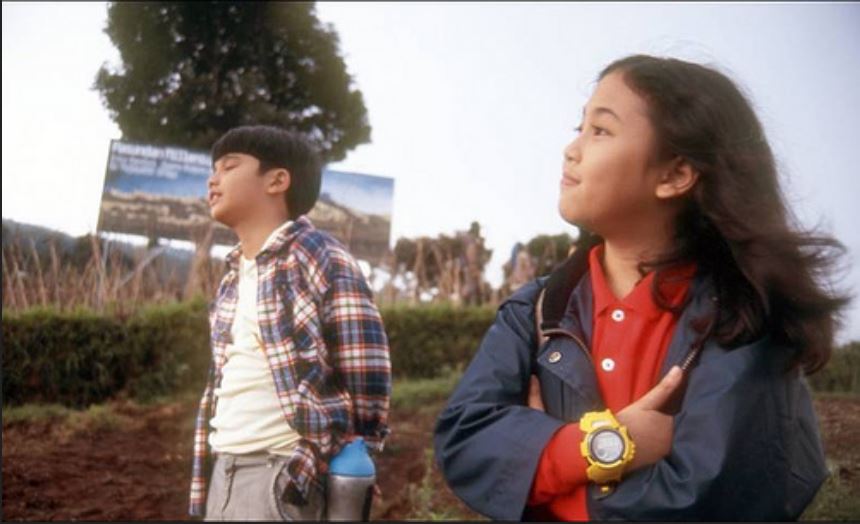
Now I ponder over my friend’s opinion, especially on Petualangan Sherina (2000) and Kulari ke Pantai (2019). And I don’t think that there is a difference in how the films portray children’s play, even though they are two-decade apart.
Firstly, both films similarly represent how they value human interaction in Indonesian children’s play. Whether it is between Sherina and Sadam, or Sam and Happy, when children are playing, they will always involve other people to interact with. This may contradict with the stereotype of children’s play in the digital age, in which children become individualised and refuse to play with others.
Secondly, gadgets or digital technology serve only as a tool to make social interaction happens. This is more straightforward in Petualangan Sherina than in Kulari ke Pantai. In Petualangan Sherina, it is clear that Sherina and Sadam don’t engage with social media or digital technology. I don’t think Facebook (or Friendster??) was even invented yet in 2000.
The only communication technology that Sherina use is probably a telephone.
In Kulari ke Pantai, it is a bit hard to see how technology serves as a tool for communication, instead of replacing their play. In the film, we are presented with the fact that children and digital media are inseparable. But actually, it also represents how the children can find other ways to cope with the community even without social media.
So… if there aren’t much different in the play, then, what made my students not interested in Petualangan Sherina?
… Maybe they are just bored with the school and find this movie period as their free time. Who knows?
Image source: http://milesfilms.net/en/petualangan-sherina/ (header)
 Not a food blog
This is interesting Rina. There could be many reasons why the children didn’t seem to be interested in this film, but I think rather than wonder why this is the case (and I’m not so sure it’s down to media …. the thing that gets the blame for many ‘modern’ societal ‘ills’!), might it be better to think about ways of involving them in the film through showing them clips/exceprts of the film and then talking about it, or introducing a few themes first or giving them things to look out for that relate to texts already familiar to them … in other words, to try out film education approaches that go beyond watching. I’m sure you’ve done this type of thing already. Having said all this, it’s always disappointing to realise that our own cultural capital may well be ephemeral.
LikeLiked by 1 person
Yes, I agree with you Michelle! I think in many schools in Indonesia we still overlook the potential of film education as an approach to develop students’ critical thinking or creativity… Instead, films are used mostly for killing time in class or entertainment just like what my school did. I also think that involving my students to go beyond films and talk about them is part of bringing an ordinary culture into class to unpack its meaning. Actually, I discuss about this more on my newest blog post (An Ordinary Teacher).
LikeLike
I guess most kids just don’t have much interest in films that are obviously from long ago. When I was a kid I hardly ever wanted to watch children films that were popular among the last generation, the reason is hard to explain though.
LikeLike