At the school where I was teaching kindergarten in 2016, it was very common to talk about negative influences of digital media and technology for our students (age 4-5). When it comes to their lack of academic performance, many teachers and parents relate it to their gadget use at home. And usually what we, teachers, advise is to limit the use of gadget for students, which parents mainly agree.
To be honest, I couldn’t say I agree or disagree with that. I’m in between. I’ve seen cases that my students actually made progress academically when their parents limit their gadget use at home. But, there are also students in my class that due to their engagement with digital media and popular culture, like watching YouTube, texting, or playing games on tablet, they are more exposed to words and sentences, thereby increasing their literacy skills. Mostly, if their literacy practice is accommodated by something that they are interested in (cartoon or favourite objects), they will engage more to the learning activity.
Therefore, at that time, I was more interested in doing exploration in media education for children, especially younger children below age 6. It was related to my situation the most.
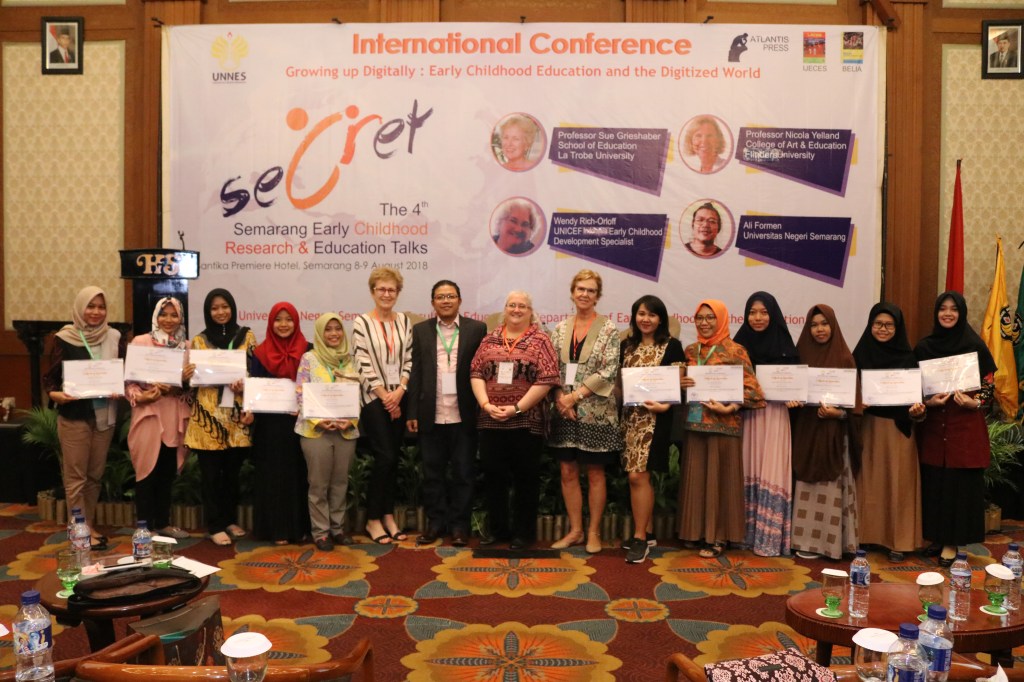
Then, few months after I quit my job, I had an opportunity to present a paper that my team at Yayasan Pengembangan Media Anak (Children’s Media Development Foundation, YPMA) at the 4th Semarang Early Childhood Research and Education Talk (SECRET) international conference in July 2018 in Semarang City, Indonesia.
I was so glad that I participated in that conference. It was my first time to encounter with people who actually try to find balance in the use of digital media and digital technology for early childhood education. It also marks my journey, where I finally started to feel like this is the path I should be walking at.
Beginning of journey: The SECRET
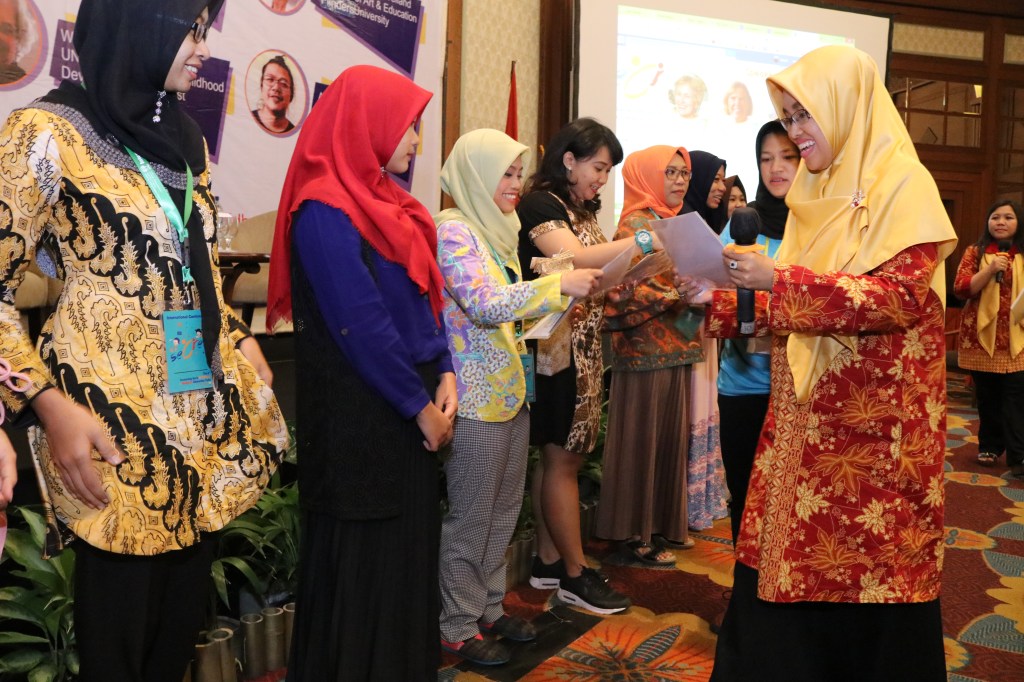
The conference that year was about the role of digital media in early years education—something that I was really into. And from that conference, I finally met with people that talk about the opportunities of using digital technologies and media in early years education, instead of condemning about it like most of early year childhood teachers in Indonesia.
In my opinion, in this digital era, we as adults have to start to change our perception about how we should harness digital media to educate young children, instead of taking it away from children.
The panelists were demonstrating how we could maximise the use of media—bringing what children engage at home to school. The result proved that it had influence to their learning and development. One of them, Professor Sue Grieshaber from La Trobe University, Australia, also introduced the concept of multimodality for early years education.
I also remember that one of the panelists, Professor Nicola Yelland from Flinders University, Australia, told us her experience. She went for a family dinner at a restaurant with an ocean view. Another family with two children and a baby was also present in the restaurant. One of the children, a girl, was reading a book and another one, a boy, was playing with his smartphone (or console game? I forgot—but it was a gadget for sure).
And then there were groups of dolphin jumping at the sea. People at the room were surprised and started to talk about the view. Professor Yelland’s family was looking at the dolphins of course, including the parents of the other family. However, the two kids are the point of interest here—many would think that the boy would still playing with the gadget and wouldn’t turn his head away from it to see the dolphin.

Well, the truth is, it wasn’t the boy who didn’t turn. It was the girl—she didn’t turn to see the dolphin and kept reading the book. The boy, on the other hand, turned right away to watch the dolphin flock.
By telling this story, Professor Yelland was trying to make a point about media panic. Everyone is “panicking” with the presence of digital media or digital technology that may make children become ignorant, addictive, individualists, careless, negative… but no one actually complains the same thing about traditional media such as book like in the story. It seems like many people are treating an addiction to digital media as bad, while addiction to a book is regarded as okay. But according the story, addiction to a book can make children disengage too, you know?
Turning point: A reflection
It is exactly what happened in Indonesia. Reflecting back to my experience as a kindergarten teacher and met fellow teachers, they are seem too afraid of the negative aspects of media, that they overlook the opportunities that could be raised from media.
Professor Yelland was trying to make a point about media panic. Everyone is “panicking” with the presence of digital media or digital technology that may make children become ignorant, addictive, individualists, careless, negative…
It makes me realised that we are not supposed to blame digital media —it is the the child’s behaviour towards any kinds of media that require us, as parents or responsible adults, to pay more attention to. Shaping children’s behaviour towards the media is more important because it will affect the way they interact with any kinds of media.
I believe that this could be applied not only to early years childhood but also for anyone at any age—even adults, in dealing with more complex media issues, such as handling fake news or giving critiques towards particular media texts.
Where am I now?
I’m glad that I learned the new term of “media panic” from SECRET. After the conference, I went on google scholar and read more on the term of media panic. I encountered David Buckingham’s paper about media panic and then it got me to read more of his works on media education before I started my master’s degree.
Although my focus now have shifted from early childhood to “older children” (teenagers, young people in middle and high school or universities), my interest in media education hasn’t changed. However, by looking at the situation and condition in Indonesia, I think it is more tangible to develop media education for this group of youth instead of younger children age 4 or 5. But one day, I want to try to promote more media education for young children.
Read more about media panic:
Image source: http://zoneinworkshops.com/ramifications-of-early-screen-use.html (header)
My team’s paper on the 4th SECRET: https://www.atlantis-press.com/proceedings/secret-18/25907003
 Not a food blog
One thought on “The Secret”